Media

The Fraunhofer Battery Alliance

Privacy warning

With the click on the play button an external video from www.youtube.com is loaded and started. Your data is possible transferred and stored to third party. Do not start the video if you disagree. Find more about the youtube privacy statement under the following link: https://policies.google.com/privacy

Learn more about our research in the image film of the Fraunhofer Battery Alliance.

Media from our areas of competence

Fraunhofer IKTS

Video: Solid-State Battery Manufacturing at Fraunhofer IKTS

Fraunhofer IWS

Video: Research on the batteries of the future at the Advanced Battery Technology Center (ABTC)

Fraunhofer ISI

Blog: Battery update

Fraunhofer FFB

Whitepaper »Exploring additional benefits of plastic piping«


Flyer "From the material to the cell"

Fraunhofer ITWM

Video: Simulation of the Production of Lithium-Ion Cells and Battery Packs

Fraunhofer ISIT

Video: Dry Coating Process for Battery Electrodes

Fraunhofer IKTS

Video: From Lab to Fab

Fraunhofer IWS

Video: Drytraec

Fraunhofer ISI

Study: Development perspectives for lithium-ion battery cell formats

Fraunhofer FFB

Digitalisation in battery cell production

Fraunhofer FFB

Requirements-orientated factory planning

Fraunhofer FFB

Pioneering concepts for sustainable and economical battery cell production

Fraunhofer FFB

Environment report on the European innovation system Battery 2022

Fraunhofer FFB

The digital twin in battery cell production


Flyer "Cell production"

FoxBMS

foxBMS® 2: Certification-ready open-source battery management system

Fraunhofer IISB

foxBMS® 2: Certification-ready open-source battery management system

Fraunhofer ILT

Video: Laser-based micro joining for a wide range of connections

Fraunhofer LBF

Video: Principle of the generator-electric drive unit (only on german website)

Fraunhofer IVI

Video: Underbody Charging Technology

Fraunhofer IWU

Video: Demonstrator of the function-integrated battery module 

Fraunhofer IGCV

Battery production: Additive manufactured battery cell housings with three materials

Fraunhofer IGCV

Video: Powder Bed Fusion of Battery Cell Cap Housings with Three Materials in One Process


Flyer "Systems"

Fraunhofer ISI

Study of battery recycling: Europe expands recycling of lithium-ion batteries

Fraunhofer ISI

Study of battery recycling: Recycling of lithium-ion batteries will increase strongly in Europe

Fraunhofer IKTS

Study of battery recycling: Recycling and green batteries

Fraunhofer IPA

Video: Industrial disassembly of battery modules and electric motors "DeMoBat"


Flyer "End-of-life and battery recycling"

Fraunhofer ITWM

Video: BEST – Battery and Electrochemistry Simulation Tool

Fraunhofer ITWM

Video: Simulation of Cell Aging and Degradation of Li-Ion Batteries

BaSis Simulation Studio

BaSis - Battery Simulaiton Studio

Fraunhofer ISE

NRGISE.ONE - Integrated Planning and Control of Storage Systems


Flyer "Simulation"

Fraunhofer IIS

Video: XXL computed tomography

Fraunhofer IVI

Video: Remote Battery Diagnosis


Flyer "Testing and evaluation"

Fraunhofer FFB

Study: Environment report sodium-ions

Fraunhofer IKTS

Blog: When will sodium-ion batteries be launched in Germany?

Fraunhofer IPA

Spotlight: Sodium-ion battery (only in german)

Fraunhofer ISC

Video: NaKlaR – Component development and customised recycling for sodium-ion batteries

Weiterführende Informationen

Fraunhofer IKTS

Solid-State Battery Manufacturing at Fraunhofer IKTS

Fraunhofer ISI

Roadmap:  

Solid-State Battery Roadmap 2035+

Fraunhofer ISI

Blog: Solid-state batteries for electric vehicles: Still in R&D or on the verge of commercialization?

Battery Glossar

A - Z

Abuse tests

Abuse tests are designed to ensure that high-performance batteries function faultlessly even in extreme conditions. The standard tests defined in the test regulations include:

Accumulator

See secondary cell.

Active material

Active material refers to the materials in the electrodes involved in the electrochemical reactions.

Additive

Additives are substances added to products in small quantities in order to modify their properties.

Aging

Aging is understood as a decline in deliverable capacity over the battery’s lifespan. This loss of capacity is irreversible. Calendar aging can be reduced by storing the battery at the lowest possible state of charge and at low temperatures.

Analytical methods

Analytical methods are routinely used in battery testing. The application of comprehensive analytical methods can provide qualitative evidence of gaseous reaction products, particularly when performing safety tests on modules and complete battery systems.

Anode

An anode is the electrode at which the oxidation reaction occurs. 

Battery

A battery consists of multiple galvanic elements/cells connected to form a functional entity.

Battery management system

A battery management system (BMS) is an electronic circuit that monitors and controls the charging and discharging of batteries. Battery management systems also ensure that the cell voltage remains within acceptable limits, monitor the temperature and the charge and discharge processes, and protect the battery from deep discharge.

Binder

Binder is used to manufacture electrodes. It binds the active material particles mechanically and bonds the active material with the tab.

Calender

A calender is a system of heated, polished rollers. Molten masses and other materials are pushed between the rollers. Calenders are used to compact electrodes to the right thickness and density once they have been dried.

Capacity

The capacity of a battery is the amount of charge it has available. This is measured in ampere-hours. It is the discharge current that can be discharged before the cut-off voltage is reached.

Carbon Nanotubes

Carbon nanotubes (CNT) are nanoscale cylindrical tubes made of carbon. A distinction is made between single-walled and multi-walled carbon nanotubes.
Coulomb Counting

CAN-Bus

A Controller Area Network (CAN) is a real-time-capable fieldbus for serial data transmission. It is created in compliance with the standards defined by the International Organization for Standardization (ISO). A battery management system (BMS) can use a CAN bus to provide information on numerous parameters, including the state of charge (SoC), cell voltage, cell temperature, charge / discharge current and predicted performance.

Cathode

A cathode is the electrode at which the reduction reaction occurs.

Cell

Each electrochemical energy storage device consists of at least one cell, i.e. a container that houses two electrodes in direct contact with an electrolyte at which the electrochemical reactions take place. The electrodes are electrically isolated from each other by a separator. Cells can have a closed, gas-tight design or an open design. Two electrode connections that are electrically isolated from each other, the positive pole and negative pole, project from the housing. When both poles are connected to an electronic conductor (electrical device, light bulb), current flows between them.

Ceramic

The term “ceramic” refers to a large number of inorganic and non-metallic materials. Ceramic high-performance materials with their customizable properties already play a key role in various battery systems, e.g., in sodium-based high temperature batteries.

Charge controller

A charge controller is a device used to monitor and regulate the charging process. It protects batteries from deep discharge.

Charge counter

A charge counter is a device used to estimate the battery’s state of charge.

Charge factor

The charge factor is the relationship between the amount of electricity required to fully charge the battery and the amount of charge consumed. Depending on the type of battery, this varies between 1.2 and 1.5.

Charging methods

When recharging batteries, various methods are used to control the timing and the charging current / voltage profiles depending on the electrochemical system and battery design. There are several charging methods controlled by voltage, current and time. These include constant-voltage charging, constant-current charging, pulse charging, constant-current constant-voltage charging (CCCV) and reverse-current charging.

Charging station

The terms “charging station” and “charging system” are used not only for electric vehicles but also for chargers used with battery-powered devices such as smartphones, digital cameras, cellphones and cordless screwdrivers. In the context of electric mobility, a charging station is an electric “fuel pump” for recharging the batteries of electric vehicles.

Coating


Coating is a key stage in the process of creating an electrode. During the coating process, a liquid suspension consisting of the active material, a polymer binder, further additives (optional) and a solvent is applied to a metal carrier foil in thin layers. Various coating methods can be used to apply the coating paste to the carrier foil, including doctor blade coating, slot-die coating and anilox roller coating.

Conducting salts

Conducting salts are dissolved in electrolytes and transport the charge without participating in the reaction.

Conductivity

Conductivity is the ability of a material to transport charge carriers, especially electrons and ions. The conductivity of the electrodes and electrolyte plays a key role in electrochemical systems.

Connection technology

Connection technology encompasses all the technological subprocesses required to manufacture battery systems. Connection technologies help push back the boundaries toward longer service life, higher operating temperatures and smaller, lighter modules.

Cooling system

The battery cooling system ensures that the battery does not overheat during charging and that the risk of explosion is minimized. The optimum temperature range is between 20 and 35 degrees Celsius. Batteries are cooled either by air or by liquid.

Coulomb counting

Current integration method used to determine the state of charge.

Current collector

A current collector is a structure within the electrode that allows electricity to flow between the poles of the cell and the active materials.

Cut-off voltage

The cut-off voltage is the voltage at which the cell or battery is fully discharged. Cut-off voltages vary depending on the type of battery.

Cycle

A cycle consists of a charge followed by a discharge.

Cycle stability 

Cycle stability refers to the number of cycles a battery can undergo before its capacity falls below a specified percentage of its initial capacity. 

Cyclovoltammetry

Cyclovoltammetry is characterized by applying a triangular potential-time profile to the working electrode and recording the resulting current-potential curve.

Cylindrical cell

In a cylindrical cell, the two ribbon-shaped electrodes are wound into a coil with two separators between the layers.

Depth of discharge

The depth of discharge (DOD) indicates the ratio of the amount of electrical charge withdrawn (usually in ampere-hours, Ah) to the total capacity.

Doping

In battery technology, doping refers to the introduction of foreign atoms into a layer, for example into an electrode. The amount introduced during this process is very small compared to the host material (typically between 0.1 and 100 ppm).

Efficiency

Ratio of discharged capacity to charged capacity; in a lead battery, it is approx. 0.85.

Electrocatalysis 

Electrocatalysis is a subfield of heterogeneous catalysis. The objective is to develop electrochemically highly active and stable catalyst materials for use in electrodes.

Electrode

The electrode is a conductive part of the electrochemical cell. Electrodes normally consist of an active material and a tab.

Electrolyte

Electrolytes are chemical compounds that dissociate into ions in the solid, liquid or dissolved state. The electrolyte conducts electric current.

End of charging voltage

The end of charging voltage is the voltage at which the cell or battery is fully charged.

Energy density 

Energy density is the amount of energy stored in a cell. It is calculated using either the volume or the weight of the batteries (in Wh/L or Wh/kg).

Film technology

Film technology describes the processing of active powder into thin electrode foils.

Flammability

Flammability refers to a material’s ability to burn or ignite.

Gas analysis

Gas analysis is a subfield of analytical science. It involves the use of chemical and physical methods to examine the qualitative and quantitative composition of gases and gas mixtures. Chromatographic analysis, for example, can quantify the gaseous and in some cases toxic components emitted during battery abuse tests down to the number of parts per million (ppm).

Graphite

Like diamond and fullerene, graphite is a carbon allotrope and a naturally occurring mineral—albeit a rare one. It is the standard material used for the anodes in lithium-ion batteries.

High-temperature battery

A high-temperature battery is a battery whose required operating temperature is significantly higher than normal ambient temperatures. The most well-known of this type is the ZEBRA battery, a rechargeable sodium-nickel chloride battery. Its operating temperature is approximately 300 degrees Celsius.

Housing

The housing is the battery case containing the plate packs, connectors and electrolyte.

Hybrid system

In the battery industry, a hybrid system is one which combines a component with high energy density but unsatisfactory power density (e.g., a fuel cell) with a system that offers high power density.

Impedance

Impedance (Z) is the apparent resistance of an alternating current circuit to current. It is composed of reactance and ohmic resistance.

Impedance spectroscopy

Impedance spectroscopy is a non-invasive method for characterizing the frequency-dependent electrical properties of an electrochemical system. The resulting spectra can be used to draw conclusions about electrical transport mechanisms and the mobility of charge carriers.

Internal resistance

Internal resistance is the sum of all types of resistance inside a battery. As the current increases, so does the voltage drop across the battery’s internal resistance, thus decreasing the terminal voltage. The individual components of internal resistance are the polarization resistance generated by electrochemical reactions, resistance to ion flow and ohmic resistance at the electrodes.

Ion conductor

An ion conductor is a gas, solid or liquid in which an electric charge is transported by ions rather than electrons. Typical ion conductors include ionized gases and electrolytes.

Joule

Unit of energy. 1 joule is roughly equivalent to the energy needed to lift 100 g by one meter. The term “watt-second” (Ws) is sometimes used instead of “joule.”

Lead-acid battery

In a lead-acid battery, the positive active material consists of lead dioxide (PbO2), the negative active material of lead and the electrolyte of aqueous sulfuric acid.

Lithium-ion battery

The lithium-ion battery (Li-ion) has a high gravimetric energy density (up to 200 Wh/kg). It is thermally stable, has a low self-discharge rate and nearly no memory effect. A lithium-ion battery is based on the exchange of lithium ions between the two electrodes. There are many variants of lithium-ion systems, ranging from lithium-ion polymer batteries and lithium-manganese batteries to lithium-titanate batteries and environmentally friendly lithium-iron phosphate batteries.

Lithium-oxygen battery

Lithium-oxygen (Li-O2) batteries with a theoretical energy density of over 10,000 mAh/g are a promising technology. The greatest challenge is achieving a sufficient cycle life. Lithium oxide and peroxide, which are formed during discharge, are insoluble and tend to block the pores of the cathode, which results in capacity losses. To achieve a breakthrough, new catalysts and stable, safe electrolytes must be researched.

Lithium-sulfur battery

Of all stable material combinations, the lithium-sulfur (Li-S) battery has the highest theoretical capacity (1,672 mAh/g). Despite a low cell voltage of approximately 2.1 V, lithium-sulfur batteries can achieve energy densities of between 200 and 500 Wh/kg, which is significantly higher than that of intercalation systems (150–220 Wh/kg).

Other advantages are that sulfur is very cheap and available in large quantities worldwide. Moreover, Li-S batteries can also operate at low temperatures. However, they have yet to be commercialized, as the cycle stability is low and the cells have a high self-discharge rate and a low level of efficiency. 

Membrane

A membrane is a thin layer of material that is capable of influencing the transport of specific substances passing through it. In redox flow batteries, the two electrolytes are separated by a membrane through which the ion exchange occurs.

Memory effect

The memory effect is a loss of capacity in an accumulator caused by frequent partial discharge. Instead of its full original capacity, the battery only provides the amount of energy used in previous discharge cycles. The memory effect is a phenomenon to which nickel-cadmium accumulators are particularly prone.

Modeling

Modeling provides deep insights into the processes taking place in the energy storage system and facilitates optimization of the battery design. Customized, efficient simulation models are indispensable when designing the electrical and thermal elements of the overall system. Measurement data from storage cells or detailed models are used as the basis for simplified cell models that are capable of accurately describing electrical and thermal operating behavior.

Module

A module is made up of multiple cells connected together.

Nickel–metal hydride battery

Nickel metal-hydride batteries are an evolution of nickel-cadmium batteries. The anode is a hydrogen storage electrode. The cathode consists of a sheet of nickel hydroxide. During the battery’s charging process, atomic hydrogen is produced at the negative electrode and immediately absorbed into the electrode’s crystal lattice (formation of the metal hydride). This reaction is reversed during the cell discharge process so that the stored hydrogen is oxidized at the electrode surface. With an energy density of approximately 80 Wh/kg, nickel metal-hydride batteries are used in small electronic devices, such as flashlights, cellphones or digital cameras.

Nominal capacity

The nominal capacity of a battery is the amount of charge it has available. This is measured in ampere-hours. It is the discharge current that can be discharged before the cut-off voltage is reached.

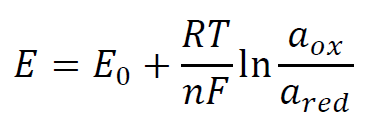
Nernst equation

The Nernst equation describes the dependence of a redox electrode’s equilibrium potential E on concentration.

Open-circuit voltage

Open-circuit voltage is the voltage of an accumulator when no current is flowing, i.e., when no load is connected.

Oxidation

Oxidation is a chemical process that occurs at the negatively charged electrode. This is where electrons are released.

Power density

A battery’s power can be calculated by multiplying the number of Amps by the battery’s terminal voltage. Dividing the power output by the battery weight yields the element’s power density in W/kg. In electric vehicles, for example, the energy density of a battery at a set weight decides the range of the vehicle.

Primary cell

If one or both of a cell’s electrode reactions are irreversible, the cell is referred to as a primary cell.

Recycling

Battery recycling refers to the reuse of materials from batteries and accumulators to recover the elements they contain, such as lead, cadmium and zinc. The law requires consumers to return used batteries, while retailers, waste management organizations, manufacturers and importers are required to take them back.

Redox flow battery

A redox flow battery consists of two liquid electrolytes that are separated by a membrane and stored in external tanks. This makes it easier to decouple power (membrane) and capacity (tank contents). The energy is actually stored in chemical compounds (via reduction and oxidation), similar to conventional rechargeable batteries. One advantage is the possibility of rapid charging by fluid exchange. They already have an energy density comparable to that of lead batteries, yet their service life is nearly ten times longer.

Residual capacity

Residual capacity is the capacity remaining after the battery is discharged.

Resistance

Electrical resistance is a measure of how much voltage is required for a certain rate of current to flow through an electrical conductor (resistor).

Safety

Testing battery safety plays a key role in the development and widespread adoption of electric transportation. Functional safety and battery reliability must be assessed. Furthermore, abuse tests are conducted to simulate battery behavior under fault conditions, in extreme environments or in the event of misuse.

Secondary cell

A cell that can be recharged and, once it has been charged, supply power again, is known as a secondary cell.

Separator

A separator electrically separates the cathode and anode from each other in an accumulator. It forms an electrical barrier through which ions can pass through for the electrochemical reaction. Separators are thin and microporous. They are flexible and consist of a membrane or nonwoven material, which contains the electrolyte. The thinner the separator, the higher the achievable packing and power density.

Short circuit

A short circuit is a closed electrical circuit without a load. In batteries, a distinction is made between internal and external short circuits. An internal short circuit can occur when dendrites grow through the separator. An external short circuit occurs for example when the two poles of a battery are directly connected.

Silicon anode

Silicon is currently considered one of the most promising anode materials for lithium-ion batteries in international battery research. The semiconductors must be nanostructured in order to control volume changes during lithium deposition and dissolution. Silicon nanowire anodes have more than 10 times the capacity of conventional graphite electrodes.

Simulation

Computer simulations can not only help assess the performance of potential new battery cells but also improve understanding of the underlying microscopic mechanisms. This facilitates a more efficient approach to battery development.

Solvent

A solvent is an organic or inorganic compound used to dissolve gases, liquids or solids without chemically reacting with the substances it dissolves.

Spinel

Spinels are chemical compounds of the general type AB2X4, where A and B are metal cations whose oxidation states add up to 8 and X is typically a divalent oxygen or sulfur anion. The positive electrode material LiMn2O4 in a lithium-ion accumulator is an example of this. 

State of charge (SoC)

The SoC value denotes the remaining available capacity of a battery in relation to its nominal charge value.

State of function (SoF)

State of function reflects the battery’s readiness to provide usable energy. One example of this is the battery power level needed to start the combustion engine of a motor vehicle.

State of health (SoH)

State of health indicates the battery’s status in terms of its ability to fulfil its specifications in comparison with a new battery. 

Super capacitors

Super capacitors are high-performance capacitors that can store energy released when vehicles are braked and deliver it when needed (regenerative braking).Super capacitors are high-performance capacitors that can store energy released when vehicles are braked and deliver it when needed (regenerative braking).

System integration

System integration refers to the process of assembling individual technical components into a functional overall system.

Terminal voltage

Terminal voltage is the voltage measured between electrodes.

Thermal management

Thermal management for electrical powertrains involves the development of approaches and solutions designed to optimize the use of energy flows in electric vehicles.

Thermal runaway

Thermal runaway refers to the overheating and destruction of primary and secondary cells that can occur in extreme situations. Thermal runaway results from excessive, self-accelerating heat generation within the cells and/or insufficient heat dissipation to the surroundings. It may lead to fire and explosions.

Virtual battery

A virtual battery consists of a bidirectional power supply combined with a control computer. The computer is controlled in such a way that the terminal behavior of the power supply matches that of a real battery. Various prototypes of virtual batteries are being used by some businesses in the automotive industry.